
Unraveling Inventory Inaccuracies: Lessons from a Two-Stage Production Environment
In my work as an inventory optimization consultant, I help companies diagnose and fix persistent inventory record problems. Recently, a mid-sized manufacturer reached out because their inventory records were becoming increasingly unreliable. What started as minor discrepancies had grown into significant inaccuracies, affecting production planning, material availability, and the reputation of manufacturing.
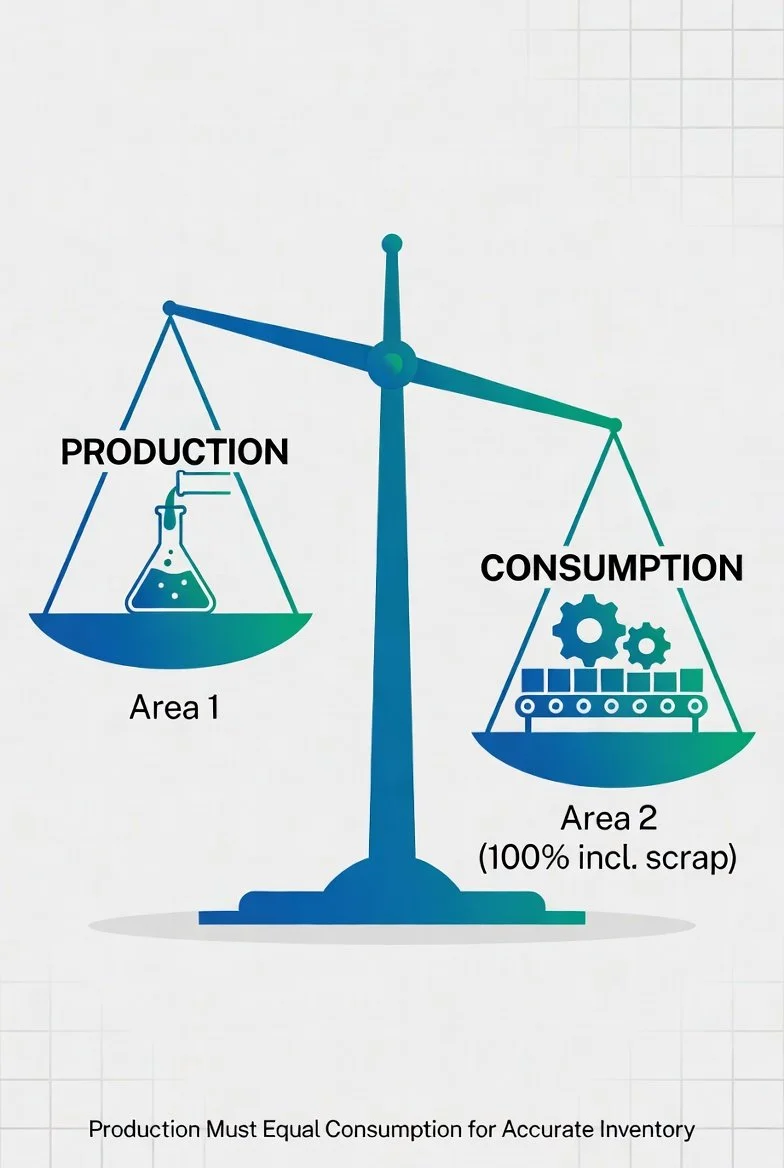
The company operates a two-stage production process. Production Area 1 generates a liquid intermediate that feeds directly into Production Area 2. In theory, this should be straightforward balance: everything produced in Area 1 should be consumed in Area 2. In practice, inaccuracies were growing as unbalanced transactions were entered. Here’s what I discovered during the investigation, along with the root causes and practical fixes that delivered results.
The Core Challenge: Production Must Balance with Consumption
The balance of inventory is highly dependent on 100% of the liquid produced in Area 1 being consumed by transactions in Area 2. This included both usable product and any scrap or waste generated during transfer or processing. If even a small portion of the liquid wasn’t properly accounted for in consumption transactions, the inventory balance for the intermediate liquid would drift. The system then thinks that small amounts of liquid still exist, and since the company produces many different variations of these liquids, there were many SKUs showing inventory that didn’t really exist.
Key insight: In multi-stage processes, especially with intermediates or by-products, production and consumption records must be forced to balance. Partial consumption or untracked scrap quickly creates “phantom” inventory that doesn’t actually exist on the floor. The existence of this inventory also inflates the cost of inventory.
Without this discipline, inaccurate records begin to impact financial reporting, invoicing and skew future inventory needs (purchase decisions).
Issue #2: Transactions Recorded Out of Sequence
A second major contributor was the timing and order of system transactions. Employees generally understood what needed to be recorded (bring in raw materials, production completion in Area 1, consumption in Area 2), but some were unaware of a critical sequencing rule:
You cannot consume inventory that has not yet been logged into the system. [Author’s note: This ERP system will let you consume inventory that doesn’t exist. If you do, it shows a negative number for on-hand inventory.]
Production staff in Area 2 would occasionally record consumption transactions before the corresponding production transaction from Area 1 had been entered. The system would accept the transaction and create negative inventory.
Practical observation: In real-time or near-real-time inventory systems, transaction ordering is as important as transaction accuracy. A simple reminder or visual queue (e.g., “Check for prior production transaction before consuming”) can prevent cascading errors… but in the end, you must still rely in human diligence.
Issue #3: Institutional Knowledge Lost to Turnover
The third factor was familiar to many growing manufacturers: regular employee turnover. Experienced operators who intuitively understood the balancing requirements and sequencing nuances had left, and that tribal knowledge was never formally captured in Standard Operating Procedures (SOPs).
Newer employees wrote and followed the SOP but critical checks and balance requirements weren’t documented. The newer employees hadn’t been taught this information. Over time, turnover had created a slow erosion of data integrity that became visible only when inventory variances reached noticeable levels.
How We Addressed the Problems
Working closely with the operations team, we implemented a targeted set of improvements:
Updated SOPs with explicit balancing rules: Added clear instructions and decision trees covering 100% consumption (including scrap allocation), transaction sequencing, and dependency checks.
Process controls: Introduced a quick pre-consumption verification step and provided short, role-specific training sessions.
System usage changes: We recommended that system alert warning of negative inventory should be investigated and transactions should not be recorded until the issue is resolved. There is no accurate scenario where inventory should go negative. Negative inventory is a clear indicator that something went wrong and a correction is needed.
Knowledge retention mechanisms: Recommended using the enhanced SOP for employee onboarding rather than relying on verbal training from one employee to another in addition to cross-training. As with many smaller companies, the bench depth is 1.
Broader Lessons for Manufacturers
This case highlights several universal truths in inventory management:
Intermediates demand strict balancing rules
Transaction discipline and timing matters
SOPs must evolve to over additional sources of error
Employee turnover in the absence of SOPs is a dangerous combination
Data integrity is foundational: It enables better demand forecasting, SKU rationalization, lead time analysis, and overall supply chain performance.
For companies running complex or multi-stage production, small process gaps can create surprisingly large problems. Addressing them early through a combination of process refinement, training, and targeted system controls pays dividends quickly.
If your organization sees growing inventory discrepancies, particularly in environments with intermediates, by-products, or high turnover, I’d be happy to help investigate. Whether through a targeted assessment, updated SOPs, Excel-based diagnostic tools, or custom AI prompts for ongoing analysis, restoring trust in your inventory data is one of the highest-ROI projects you can undertake.
Tracey Smith is President & Principal Consultant at Numerical Insights LLC, specializing in inventory optimization, demand forecasting, and data-driven supply chain improvements. She helps mid-sized manufacturers turn messy data into actionable insights.